
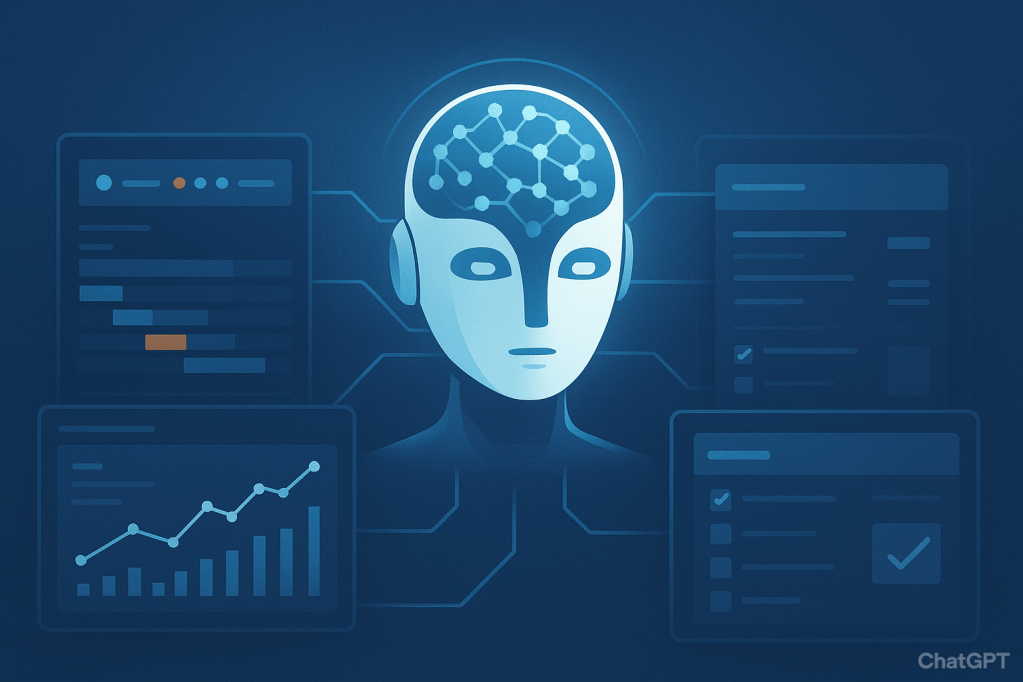
Artificial intelligence has already transformed how we communicate, analyze data, and generate content. But for project managers, the real revolution is just beginning. We’ve moved beyond using tools like ChatGPT for quick answers or report summaries. The next frontier is AI agents — autonomous, context-aware systems capable of performing complex project management tasks with minimal human intervention.
These intelligent agents are redefining how projects are planned, executed, and monitored. In this article, we’ll explore what AI agents are, how they differ from traditional AI tools, and how they are already reshaping project management practices for forward-thinking organizations.
From Chatbots to Agents: What’s the Difference?
While tools like ChatGPT respond to queries and assist with knowledge-based tasks, AI agents go a step further — they act on behalf of the user.
A chatbot answers questions like:
“What’s our project timeline look like this month?”
An AI agent, on the other hand, can automatically pull data from your project management software, update timelines, identify late deliverables, send notifications to stakeholders, and even suggest adjustments to meet deadlines.
These agents integrate with multiple tools — Microsoft Project, Jira, Slack, Excel, Trello, and CRM systems — creating a continuous feedback loop between human input and machine-driven action. In other words, they don’t just respond — they manage.
How AI Agents Are Changing the Project Manager’s Role
AI agents are not replacing project managers — they’re augmenting them. Think of them as digital co-managers who handle routine operations, freeing up human PMs for leadership and strategic thinking.
Here’s how AI agents are being applied across key project domains:
1. Automating Project Setup and Planning
Imagine starting a new software development project. Instead of manually creating task hierarchies and timelines, an AI agent can:
- Analyze the project charter and generate a work breakdown structure (WBS) automatically.
- Assign resources based on skill, availability, and historical performance.
- Predict risk hotspots by comparing your plan against similar past projects.
Example:
A telecom company implementing a new billing platform uses an AI planning agent that reviews historical rollout data. It identifies that data migration usually causes delays and recommends starting that workstream earlier.
Result: Planning efficiency increases, and historical pain points are addressed before the first milestone even begins.
2. AI-Driven Progress Monitoring and Reporting
Project reporting is one of the most time-consuming activities for PMs. AI agents are automating this through real-time dashboards and predictive alerts.
An AI agent integrated with your PM tool can:
- Pull live updates from Jira, Asana, or MS Project.
- Generate weekly executive summaries.
- Highlight bottlenecks and overdue tasks.
- Forecast the likelihood of schedule slippage or cost overruns.
Example:
In a marketing campaign rollout, an AI monitoring agent detects that two dependent content deliverables have been delayed by external vendors. It automatically recalculates the campaign’s critical path, adjusts the timeline, and sends a proactive update to the project sponsor.
This eliminates the lag between issue detection and human response — saving time and preventing cascading delays.
3. Smart Resource Management and Workload Balancing
AI agents also help manage resource allocation dynamically. By analyzing employee workloads, vacation calendars, and skill utilization, they can optimize who works on what — in real time.
Example:
In an engineering project, an AI resource agent notices one team member is consistently assigned more critical-path tasks than others. It automatically redistributes work among equally qualified team members and alerts the PM to potential burnout risks.
This level of predictive workload balancing keeps teams healthy and projects on track.
4. Risk Identification and Mitigation Through Predictive Analysis
AI agents can continuously monitor performance data and risk registers to identify emerging threats. They cross-analyze multiple data sources — project performance metrics, communication tone in Slack, and even sentiment in stakeholder feedback — to surface hidden risks.
Example:
In a construction project, an AI risk agent correlates supplier delivery records and local weather data to predict a potential two-week delay in material availability. It suggests ordering contingencies or rescheduling site work accordingly.
Instead of reacting to problems, AI agents enable project managers to mitigate before impact.
5. Stakeholder Communication and Reporting
AI agents can act as communication liaisons, drafting stakeholder updates, progress summaries, or risk escalation messages in the appropriate tone and format.
Example:
A project manager for an IT modernization initiative uses an AI communication agent that automatically tailors updates:
- Executives receive concise KPI summaries.
- Team members get detailed sprint goals.
- Clients receive milestone progress reports.
This level of automation keeps all parties informed, consistent, and aligned — without manual reporting overhead.
The Technology Behind AI Agents
What makes AI agents so capable? They combine several AI technologies under one hood:
- Large Language Models (LLMs): Provide contextual understanding and generate human-like responses.
- Machine Learning (ML): Learns from project history to predict risks, workloads, and outcomes.
- Natural Language Processing (NLP): Allows communication in plain English between humans and systems.
- Integration APIs: Connect agents with tools like Jira, Slack, and MS Teams for real-time data.
- Autonomous Decision Engines: Empower agents to act on defined thresholds or triggers.
Together, these technologies enable continuous learning and action — a defining feature of intelligent project ecosystems.
Challenges and Cautions
While AI agents bring exciting capabilities, they also raise important considerations:
- Data Security: Agents must handle sensitive data securely, especially in regulated industries.
- Decision Transparency: AI-driven decisions should remain auditable and explainable.
- Change Management: Teams must adapt to working alongside non-human collaborators.
- Bias and Overreliance: AI recommendations should always be validated by human oversight.
Project managers must learn to treat AI agents not as “black boxes” but as collaborative assistants whose insights complement human expertise.
Looking Ahead: The Future of AI in Project Management
Within the next three to five years, AI agents will evolve from simple assistants into autonomous project ecosystems. Imagine a virtual PMO where:
- AI agents coordinate entire project portfolios.
- Real-time data triggers automatic re-prioritization of resources.
- Predictive models continuously optimize delivery performance.
Forward-looking organizations are already training custom AI models on their internal project archives, enabling predictive governance across departments. For project managers, the opportunity is clear: embrace these technologies now to stay competitive, agile, and relevant.
The next wave of AI agents won’t replace project managers — it will elevate them to new levels of insight, efficiency, and strategic impact.
 CA Project Intelligence
Leave a comment