
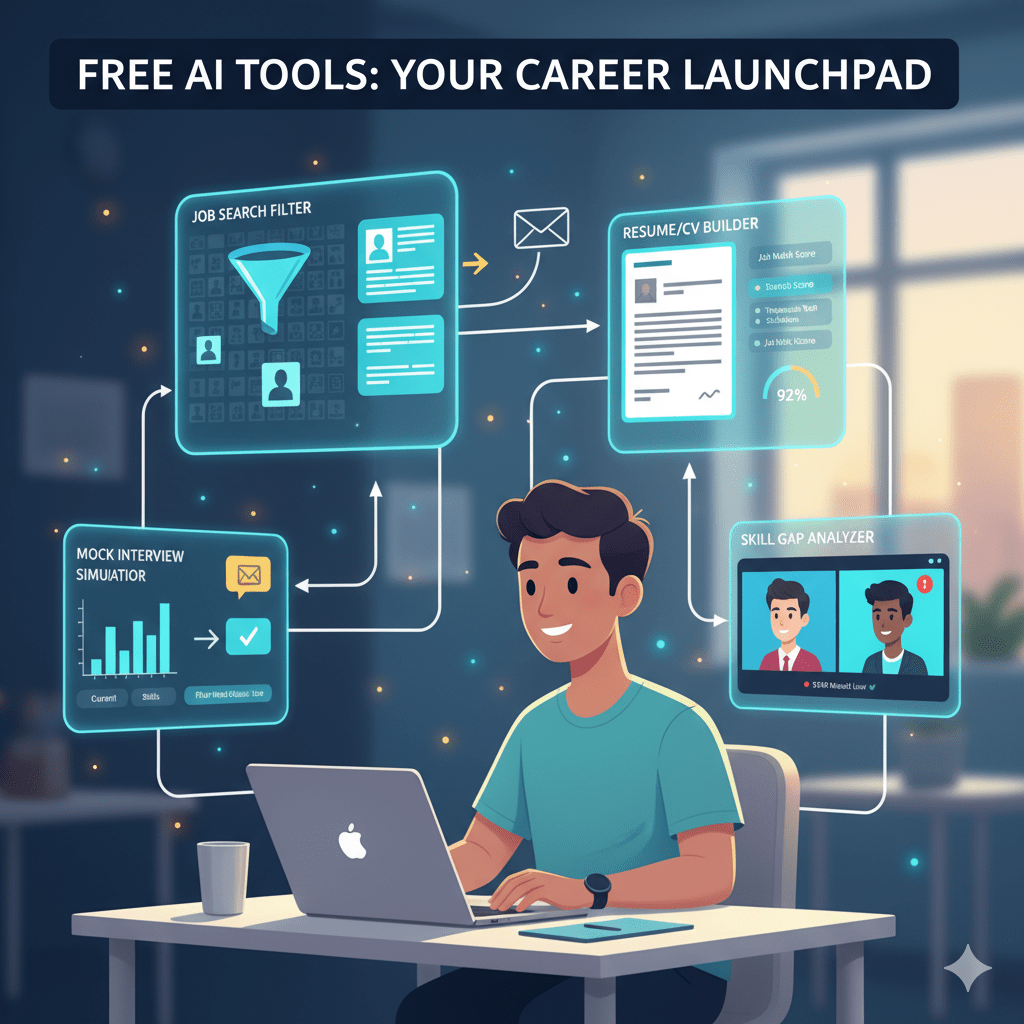
The job market can feel like a labyrinth, especially for those just starting their professional journey. Crafting a standout CV, writing a compelling cover letter, and acing interviews often require skills that take time to develop. But what if you had a secret weapon? Enter the world of Artificial Intelligence. Far from being a futuristic fantasy, free AI tools are readily available and can be game-changers for early career professionals seeking to make a lasting impression.
This isn’t about replacing your unique voice or genuine enthusiasm; it’s about leveraging powerful technology to refine your message, polish your presentation, and boost your confidence. Think of AI as your personal career coach, offering insights and assistance that were once the exclusive domain of expensive consultants.
Section 1: The AI Filter—Finding the Needle in the Job Haystack
Before you can apply, you have to find the right job. Sifting through thousands of irrelevant postings is the most time-consuming and demotivating part of the job hunt. AI tools excel at this pre-filtering, matching your profile and preferences to job descriptions with sophisticated accuracy.
1. AI-Powered Job Matchers and Aggregators:
Unlike traditional job boards that rely only on simple keyword matches, modern AI tools learn from your CV, your stated career goals, and even which jobs you save or discard.
- Teal (Free Tier): Teal is a superb all-in-one job tracker. You can save job listings from various boards using their browser extension. Where the AI shines is in providing a Job Match Score by comparing your resume to the specific job description. It highlights the keywords the job description uses and suggests how to tailor your resume to boost your compatibility score, instantly directing your focus to the most relevant jobs.
- WonsultingAI (Free Tools): Wonsulting’s suite, including JobBoardAI, helps match you to relevant jobs and even tailors your documents instantly. For job filtering, it ensures that your application efforts are focused on roles where you have the highest probability of success.
- LoopCV (Free/Trial Features): LoopCV is one of the more aggressive automation tools. While full auto-applying often requires a paid plan, its free features often include job discovery and advanced filtering based on your uploaded CV, job titles, and location preferences, helping you manage a high volume of job opportunities.
Delivering Relevant Postings Straight to Your Inbox:
The key to automating your job search is setting up intelligent, multi-source alerts that bypass generic notifications.
- Platform Alerts: Major platforms like LinkedIn, Indeed, and Glassdoor use AI to refine their daily or weekly email alerts. You must train them by using specific titles and keywords, and critically, by interacting with the suggestions—saving the good ones and dismissing the bad ones. The AI learns from this feedback loop.
- Job Tracker Integrations: Tools like Teal and Careerflow act as central hubs. Once you’ve tracked jobs that interest you, their systems can often generate personalized recommendations and reminders, sometimes delivered as email digests, that ensure you don’t miss new postings that perfectly align with your defined “ideal job” profile.
- Leveraging IFTTT (If This Then That) or N8N (Advanced Automation): For the technically inclined, no-code automation platforms like IFTTT can create custom “Applets” that connect job boards (like some remote work sites) to your email or a Google Sheet. While not strictly AI-powered, this automation process, combined with highly specific search queries (refined by AI research), ensures a continuous flow of filtered, relevant data without constant manual checking.
Section 2: Crafting a CV That Commands Attention
Your CV is often the first, and sometimes only, impression a recruiter gets. In a sea of applications, how do you ensure yours rises to the top?
1. AI-Powered Resume Builders & Optimizers:
- Kickresume (Free Tier): Offers excellent free templates and a basic AI assistant to help you phrase bullet points effectively.
- Resume.io (Limited Free Features): Provides professional templates and includes basic keyword optimization to help your CV pass Applicant Tracking Systems (ATS) that scan resumes for relevance.
- ChatGPT or Google Bard (for content generation and refinement): This is your most versatile tool. Copy and paste a job description along with a draft of your CV and ask the AI to:
- “Compare my CV against this job description and suggest 5 bullet points to better highlight my experience in [Required Skill].”
- “Rewrite my existing bullet points using the XYZ/STAR method to make them results-oriented and quantifiable.”
Section 3: Writing Cover Letters That Open Doors
A cover letter is your chance to tell a story and connect your experiences to the company’s specific needs.
1. AI for Tailored Content:
- ChatGPT or Google Bard (for drafting and customization): Provide the AI with: 1) The job description, 2) A few key experiences from your CV you want to highlight, and 3) The name and mission of the company.
- Then, ask it to: “Draft a concise, one-page cover letter for the [Job Title] position at [Company Name]. Make sure to reference their recent [Project/Mission] and emphasize my experience in [Skill 1] and [Skill 2].”
The AI provides structure and keyword integration; you inject the authentic enthusiasm and specific achievement metrics.
Section 4: Mastering the Interview
The interview is your chance to shine, but practice is crucial. AI offers a low-stakes environment for simulation and detailed critique.
1. AI for Mock Interviews & Feedback:
- WonsultingAI’s InterviewAI (Free/Trial Features): Designed specifically for job seekers, this tool can run realistic interview simulations, asking role-specific behavioral and technical questions, and offering detailed feedback on your answers.
- ChatGPT or Google Bard (Your Personal Interview Coach):
- Simulated Interviews: Ask: “Act as an interviewer for a [Job Title] position. Ask me three common interview questions, and after each of my answers, provide constructive feedback on clarity, structure (like STAR), and impact.”
- Question Brainstorming: Ask: “What are the most challenging technical and behavioral questions asked for a [Job Title] role at a company in the [Industry] sector? I need to practice my answers.”
This practice helps you refine your examples and gain the clarity and confidence needed to impress a human interviewer.
Section 5: Beyond the Application: Continuous Improvement
Your job search is a continuous cycle of learning and optimization. AI helps you analyze your efforts and close skill gaps.
- Skill Gap Analysis: Use AI to review multiple job descriptions for your desired career path. Ask: “Analyze these 10 job descriptions for [Job Title] and list the top 5 most frequently requested hard and soft skills. Which of these are missing from my CV?” This provides a clear, actionable roadmap for further learning or upskilling.
- Personal Branding: Ask the AI to help you draft professional summary statements for your LinkedIn profile or to articulate your unique value proposition in an effective “Elevator Pitch.”
Free AI tools are not a magic bullet, but they are incredibly powerful accelerators for early career professionals. They democratize access to high-quality career assistance, allowing you to present your best self, boost your confidence, and navigate the job market with a strategic edge. Embrace these tools, use them wisely, and watch as your job search transforms from a daunting challenge into a rewarding journey towards your ideal career.
 CA Project Intelligence