
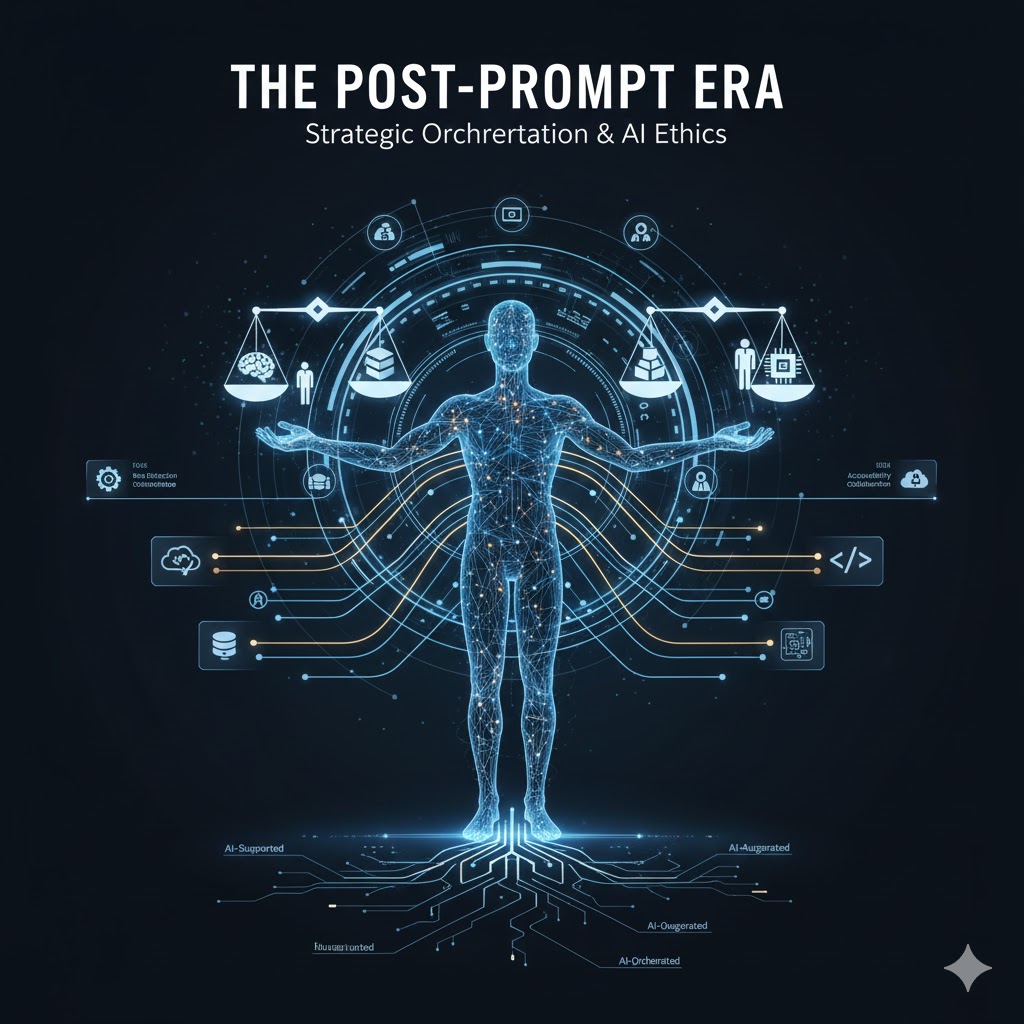
For the past few years, the corporate world has been obsessed with “The Prompt.” Professionals across every vertical have scrambled to master the art of whispering to Large Language Models (LLMs) to generate code, draft emails, or summarize meeting notes. But as we move into 2026, a new reality has set in: prompting is no longer a specialized skill—it is a baseline commodity.
We have officially entered the Post-Prompt Era.
In this new landscape, the technical hurdle of “using AI” has been cleared. Every member of your project team—from the junior developer to the senior stakeholder—now has a digital co-pilot integrated into their workflow. When everyone is augmented, the competitive advantage shifts. For the Project Manager, this represents the most significant leadership pivot since the transition from Waterfall to Agile. To thrive, leaders must stop being “Task Masters” and start becoming Strategic Orchestrators and AI Ethicists.
From Task Master to Strategic Orchestrator
The traditional Project Manager spent a staggering amount of time on “The What”: status updates, ticket tracking, Gantt chart maintenance, and manual resource leveling. In the Post-Prompt Era, these tasks are increasingly handled by autonomous agents. If an AI can predict a schedule slip three weeks before it happens and draft a mitigation plan, what is the role of the human leader?
The answer lies in Strategic Orchestration.
Instead of managing tasks, the modern PM manages the synergy between human creativity and machine precision. This involves:
- Curating the AI Ecosystem: Choosing the right “agentic workflows” for the team. It’s no longer just about the software (Asana, Jira, or Monday); it’s about how those tools talk to your internal data lakes to provide real-time intelligence.
- Synthesizing Multi-Agent Outputs: When three different AI agents provide three different risk forecasts, the PM must be the “Sense-Maker.” You are the one who understands the nuance of the client’s political landscape or the subtle shift in market sentiment that the data hasn’t yet captured.
- Managing the “Hybrid” Velocity: AI can produce work at a rate that human reviewers can’t always keep up with. An Orchestrator ensures that the team’s Human-in-the-Loop (HITL) checkpoints don’t become the new bottleneck.
Case Study: The “Algorithm vs. Reality” Conflict
To understand the role of the Strategic Orchestrator, consider a stylized case study in the construction of a $500M smart-infrastructure project.
The Scenario: The project’s predictive AI—integrated with BIM (Building Information Modeling) and real-time supply chain data—flags a “Critical Red” status. The algorithm predicts a 45-day delay in the installation of specialized HVAC systems due to a predicted logistics bottleneck in East Asia. The AI recommends an immediate, $2.4M pivot to a secondary, local supplier to save the schedule.
The Traditional PM Response: In a purely data-driven (or “AI-Supported”) PMO, the manager might blindly trust the machine, panic, and execute the expensive pivot to avoid the “Red” status on the dashboard.
The Strategic Orchestrator’s Response: The Orchestrator pauses. They recognize that the AI is making an inference based on historical shipping data and current port congestion. However, the Orchestrator knows something the AI doesn’t: a “soft signal.” Through a recent informal conversation with the primary supplier’s CEO, the PM knows the supplier has secretly secured a private charter fleet to bypass the congested ports—a detail not yet reflected in any public data lake.
Instead of the $2.4M pivot, the PM uses the AI’s warning as a negotiation lever. They contact the primary supplier, confirm the private charter status, and secure a contractual guarantee for the original timeline. The PM saves the $2.4M while keeping the project on track.
The Lesson: The AI provided the visibility, but the human provided the strategy. This is the essence of AI-driven project management: using machine insights to provoke better human questions, not just to dictate human answers.
The PM as the “AI Ethicist”
As AI moves from “assistant” to “autonomous collaborator,” the risks shift from technical errors to ethical ones. This is where the Project Manager must step into a role previously reserved for legal or compliance departments.
Algorithmic Bias in Project Planning AI models are trained on historical data. If your past projects were plagued by “Optimism Bias” or systemic underfunding of certain departments, the AI will likely bake those same flaws into your future forecasts. The PM must act as the ultimate “Bias Auditor,” questioning why the machine is recommending certain resource allocations and ensuring that data-driven decisions don’t inadvertently marginalize team members.
Accountability and Human Agency One of the greatest dangers of the Post-Prompt Era is “Automation Bias”—the tendency for humans to stop questioning a machine’s output. If an AI-generated procurement strategy fails, who is responsible? The PM must maintain a rigid framework of accountability, ensuring that while AI informs the decision, a human owns it. This is the cornerstone of Trustworthy AI.
Reclaiming the “Soft” in Soft Skills
Ironically, the more we automate the technical aspects of project management, the more valuable the “soft” skills become. In a world of digital twins and automated workflows, the “Human Advantage” is found in empathy and high-stakes intuition.
1. Hyper-Empathy and Change Management
The transition to an AI-augmented team is psychologically taxing. Many team members fear displacement or feel a “Meaning Crisis” as their traditional skills are automated. Leading in the Post-Prompt Era requires Hyper-Empathy—the ability to navigate the emotional landscape of a team, build psychological safety, and help individuals find their new value-add.
2. Conflict Resolution in the Loop
Tensions often rise when AI disrupts traditional hierarchies. For example, a junior analyst using AI might produce insights that challenge a senior director’s “gut feeling.” The PM must be an expert mediator, facilitating “Human-to-Human” and “Human-to-Machine” dialogues to ensure the best idea wins.
3. Intuition vs. Inference
AI excels at inference—finding patterns in data. Humans excel at intuition—the ability to make a decision when there is no data. The Strategic Orchestrator knows exactly when to lean on the data and when to override it based on the “smell” of the project.
The Path to AI-Native Leadership
Moving toward a Post-Prompt PMO is a maturity curve. It starts with AI-Supported workflows (simple task automation), moves to AI-Augmented (co-creation), and culminates in AI-Orchestrated environments.
At the highest level of maturity, the Project Manager is no longer “managing a project.” They are managing a Value Stream facilitated by a swarm of intelligent agents. They are the guardians of the project’s “Why,” the arbiters of ethical data use, and the bridge between algorithmic efficiency and human purpose.
For the ambitious leader, the directive is clear. It is no longer enough to be “AI Literate.” You must be AI-Native. This requires a CPMAI (Certified Project Manager – AI) mindset: a commitment to high-quality data, ethical oversight, and the relentless prioritization of the human elements that no algorithm can ever replicate.
The “management” of projects has been commoditized. The leadership of projects has never been more critical.
 CA Project Intelligence