
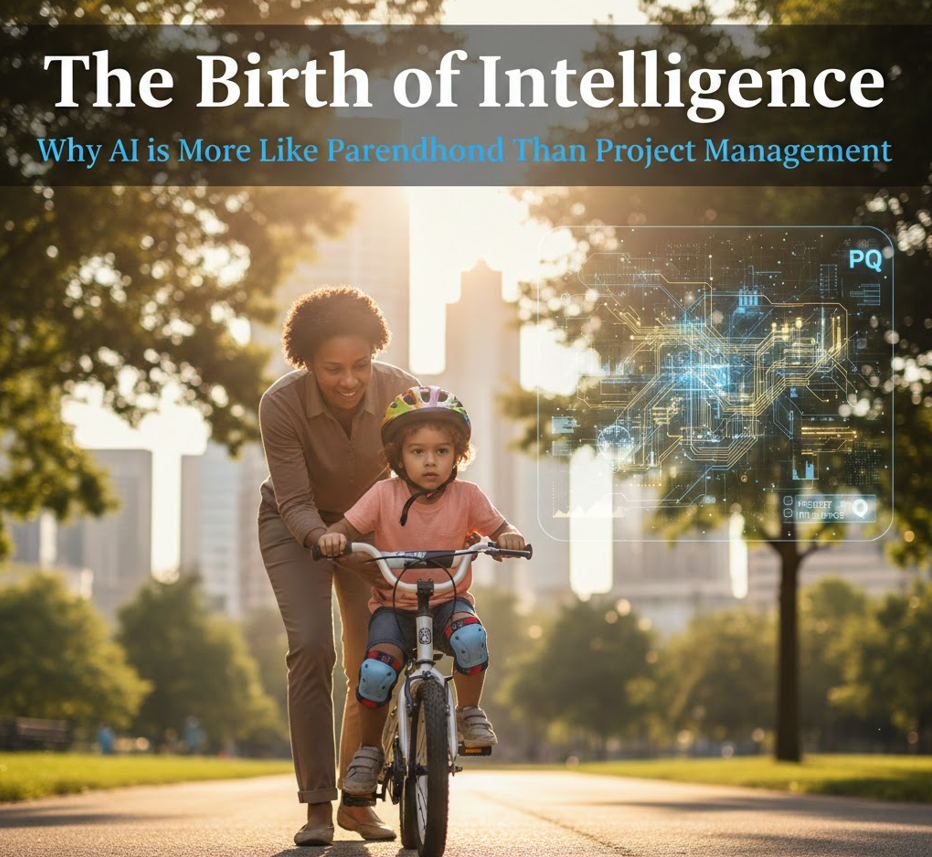
The corporate world is currently obsessed with “deploying” AI. We talk about it as if it’s a piece of office furniture—you order it, you assemble it, and it sits there doing its job. But if you’ve spent any time in the trenches of high-stakes project delivery, you know that cognitive solutions don’t follow that script.
Implementing AI isn’t a launch. It’s a birth.
When we apply the PMI-CPMAI (Cognitive Project Management for AI) methodology, we aren’t just installing software. We are becoming stewards of a living system. The investment required is significant, the commitment is lifelong, and the “birth” of the model is only the beginning. If you treat AI like a toaster, it will break. If you treat it like a child—with the structure of a disciplined framework—it will grow to transform your legacy.
The Conception: Choosing the Pattern
Before a child is born, there is a period of dreaming about who they will become. In the CPMAI framework, this is managed through the Seven Patterns of AI. You don’t just “do AI”; you decide which “personality” your cognitive solution will have.
- Hyperpersonalization: Treating every customer as a unique individual.
- Conversational: Engaging via voice, text, or image with nuance.
- Recognition: Identifying objects or patterns in unstructured chaos.
- Predictive Analytics: Foreseeing outcomes to support human decisions.
- Patterns and Anomalies: Finding the “needle in the haystack.”
- Goal-Driven Systems: Solving complex problems through trial and error.
- Autonomous Systems: Systems that act with minimal human intervention.
Choosing a pattern is like realizing your “child” has a specific talent. You must align your corporate resources to support that specific nature. You can’t ask a “Predictive” child to be a “Conversational” one without causing a developmental crisis.
Phase 1 & 2: The Prenatal Period (Business & Data Understanding)
The first two phases of CPMAI—Business Understanding and Data Understanding—are the planning and pregnancy stages.
Expectant parents prepare their homes. Similarly, a corporation must ask: Is this AI project actually feasible? This is the “Go/No-Go Filter.” Are we financially ready for the “childcare” costs of high-quality data? Do we have the nursery (infrastructure) ready to house it?
If the data is “garbage,” the child is born into a toxic environment. This stage requires a massive investment in honesty. You have to admit where your data is thin and where your goals are fuzzy. You can’t just hope for the best; you have to build the foundation.
Phase 3 & 4: Birth and Infancy (Data Preparation & Development)
Data Preparation is the labor room. It is often the most painful, grueling, and time-consuming phase of the entire project. It involves cleaning, labeling, and “sanitizing” information.
Once the data is ready, we move to Model Development. This is the birth.
The model is “alive,” but like an infant, it is entirely dependent on its creators. It knows nothing of the world yet; it only knows what you have fed it. At this stage, the investment is high-touch. You are monitoring every output the model takes, ensuring it isn’t developing biases or “crying” (failing) without reason.
Phase 5: The Formative Years (Model Evaluation)
In Model Evaluation, we put the “toddler” through its paces. Does it recognize the difference between a “risk” and an “opportunity”?
Just as parents watch a child take their first steps, project leaders must evaluate the model against real-world success criteria. If it fails to meet the metrics established in Phase 1, you don’t “throw the child away”—you iterate. You go back to the nursery (Data Preparation) and try a different approach. This is where many corporations lose heart. But this is exactly where the deepest investment in Project Intelligence pays off.
Phase 6: Operationalization—The Journey to Maturity
Many leaders think Model Operationalization is the “graduation” where the child leaves home. In reality, it is more like the first day of school.
When an AI model goes into production, the relationship changes, but the commitment intensifies. We are now in a Post-Prompt Era of parenting. You must now monitor for Model Drift—the phenomenon where the world changes (new market trends, new regulations) and the model’s “education” becomes outdated.
A healthy, growing relationship with a cognitive solution requires:
- Continuous Monitoring: Ensuring the AI hasn’t picked up “bad habits” (bias).
- Retraining Pipelines: Sending the model back to “summer school” when performance dips.
- Governance: Setting the “house rules” for how the AI interacts with the world.
The True Investment: Beyond the Checkbook
The investment a corporation makes in CPMAI-driven AI isn’t just a line item in the IT budget. It is a cultural investment.
Just as a child changes the lifestyle of the parents—requiring more patience, better communication, and a long-term view—AI changes the organization. You cannot “leave the child at the mall” and expect it to find its own way. You must build a Data-First Culture where every employee understands their role in “raising” the intelligence of the firm.
Why Corporations Fail at AI Parenting
The most common mistake? Treating AI as a Capex (Capital Expenditure) rather than an Opex (Operating Expenditure) of the soul. Firms pay for the birth but refuse to pay for the upbringing. They want the prodigy without the years of tutoring.
Implementing cognitive solutions through the CPMAI framework is a high-stakes commitment. It requires moving through the six phases with the diligence of a parent and the precision of a master project manager.
Conclusion: Are You Ready for the Responsibility?
The rewards of “raising” a successful AI are unparalleled. A mature, well-raised solution doesn’t just “do tasks”—it provides a legacy of efficiency and predictive power.
But before you start your next AI initiative, ask yourself: Are you looking for an appliance, or are you ready to raise a new generation of intelligence?
The nursery is waiting.
 CA Project Intelligence