
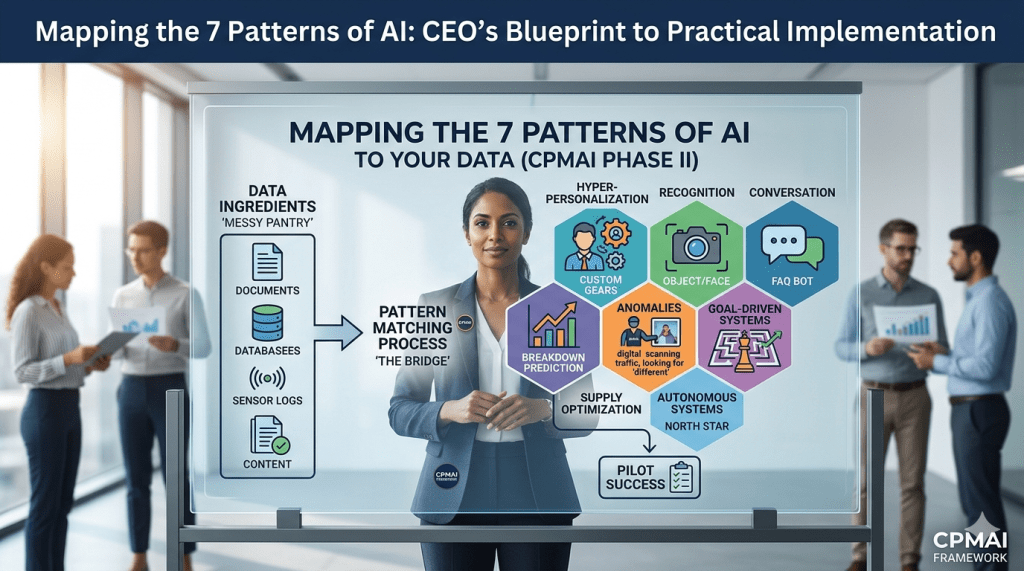
In my previous CEO Blueprint series, we explored the strategic imperative of AI. We talked about vision, board-level buy-in, and the high-level “why.” But now that the C-suite has given the green light, the implementation team is staring at a server rack like it’s a ticking time bomb. The most common question from the front lines of execution is now likely to be: “Where do we actually start with the data we have?”
Most organizations approach this backward. They fall in love with a solution—usually because they saw a flashy demo of a generative AI chatbot that can write sea shanties about supply chain management—and then they scramble to find data to feed it. This “solution-first” romance is why 80% of AI projects end in a messy, expensive breakup before they ever reach production.
To establish yourself as a leader who actually delivers, you must move into Phase II of the CPMAI (Cognitive Project Management for AI) framework: Data Understanding. Success isn’t about having the most data (sorry, data hoarders); it’s about identifying which of the 7 Patterns of AI your data is actually qualified to support.
The “Dinner Party” Disconnect
Imagine you’ve decided to host an elite, five-course Italian dinner party. You’ve invited the neighbors, bought a professional-grade pasta extruder from Milan, and even practiced your “mamma mia” in the mirror.
But at 5:00 PM, you open your pantry and realize you only have bags of jasmine rice, dried seaweed, and three pounds of fresh yellowfin tuna.
Your vision is Italian. Your equipment is Italian. But your reality? You’re making sushi. In the world of AI, your data is your set of raw ingredients. Before you commit to a recipe, you have to audit the pantry. If you try to force your “sushi” data into a “pasta” AI model, the result will be a technical catastrophe that even a hungry intern won’t swallow.
The Definitive Guide: Mapping the 7 Patterns to Your Pantry
The CPMAI methodology breaks AI down into seven distinct patterns. To be an authoritative manager of AI projects, you must be able to look at a dataset and immediately “pattern match” it to one of these functional outcomes. Let’s look at how the data you already have dictates the path you must take.
1. The Hyper-personalization Pattern (“The Personal Shopper”)
- The Data DNA: Granular behavior, individual transaction history, and real-time context.
- The Reality: Think of a regional credit union. Instead of blast-emailing 50,000 members about a generic loan—which most people delete faster than a “Final Notice” from their gym—they look at behavioral data. They notice a member has spent three Saturdays at various auto dealerships. The AI triggers a personalized mobile notification with a pre-approved rate while the member is still on the lot. * The Expert Take: If your customer data is as anonymous as a witness protection program, you aren’t ready for Pattern 1. You need “Identity-Linked” data to win here.
2. The Recognition Pattern (“The Professional Eyeball”)
- The Data DNA: Unstructured data—images, video, audio, or complex sensor “fingerprints.”
- The Reality: An insurance company gets buried under accident photos every month. Instead of making a human adjustor squint at 5,000 blurry photos of bumper dents, the Recognition Pattern “looks” at the images and identifies the damage severity instantly.
- The Expert Take: This is where “Dark Data” (unstructured files) shines. If you have a mountain of unorganized PDFs, you have a goldmine for Pattern 2.
3. The Conversation Pattern (“The Patient Librarian”)
- The Data DNA: Text-based records, chat logs, call transcripts, and clean documentation.
- The Reality: An HR department is tired of answering “How do I change my 401k?” for the eighth time today. By mapping their 300-page employee handbook to the Conversation Pattern, they create a bot that handles the routine stuff.
- The Expert Take: AI is only as smart as its source material. If your company handbook still refers to “the fax machine in the breakroom,” your chatbot is going to give some very retro (and wrong) advice.
4. The Predictive Analytics Pattern (“The Crystal Ball”)
- The Data DNA: Historical “time-series” data with clear, recorded outcomes (labels).
- The Reality: A factory wants to know when a machine will break before it starts smoking. By feeding historical sensor data into a model, the AI finds the “fingerprint” of a failing bearing days in advance.
- The Expert Take: Prediction requires hindsight. If you haven’t been recording when and why things went wrong in the past, your AI cannot tell you when they’ll go wrong next.
5. The Patterns of Anomalies (“The Digital Bouncer”)
- The Data DNA: Large volumes of “normal” operational data.
- The Reality: Think of cybersecurity or credit card fraud. The AI isn’t looking for a specific “thing”; it’s looking for anything that doesn’t look like Tuesday at 2:00 PM. It’s the bouncer who notices someone trying to enter the club through the air conditioning vent.
- The Expert Take: This pattern is the best starting point for organizations with high-volume, repetitive data but few “labeled” examples of success or failure.
6. The Goal-Driven Systems Pattern (“The Chess Grandmaster”)
- The Data DNA: A set of rules, a defined “win” state, and a sandbox to iterate in.
- The Reality: This is less about your historical database and more about “Reinforcement Learning.” Whether it’s optimizing a supply chain route or a game of AlphaGo, the AI learns by trial and error within a set of boundaries.
- The Expert Take: This is high-maturity AI. Don’t start here unless your “rules of the game” are 100% digitized and documented.
7. The Autonomous Systems Pattern (“The Ghost in the Machine”)
- The Data DNA: Real-time sensor fusion and environmental feedback loops.
- The Reality: From self-driving Teslas to warehouse robots that don’t run over the warehouse cat. It’s the culmination of Recognition, Prediction, and Goal-Driven patterns.
- The Expert Take: For most enterprise AI projects, “Autonomous” is a North Star, not a starting point. Walk before you drive.
The “Fail Fast” Loop: Why Phase II Can Change Phase I
I have a secret to tell you: It is okay to change your mind.
Sometimes, during the Data Understanding phase, you realize your “Sushi” data is simply too low-quality to ever become “Italian Dinner.” In a traditional, “waterfall” project, this would be a disaster. In the CPMAI framework, this is a success.
If your data audit reveals that your “Predictive Maintenance” goal is impossible because no one recorded the machine logs for the last two years, you must “loop back” to Phase I (Business Interest). You pivot. Maybe you change the project to “Recognition” based on the sensor photos you do have. This iterative loop is what separates the AI experts from the AI dreamers.
The Bridge: How to Speak “Data” to the Boardroom
To be the authoritative bridge in your organization, you must translate technical data gaps into business risks. When a Data Scientist says, “The dataset has high dimensionality and low label density,” you should tell the CEO:
“We have the right information, but we haven’t told the AI what ‘winning’ looks like yet. We need a human-in-the-loop to label the last six months of data before we can automate this.”
The 3-Step Expert Audit
- Inventory Your “Dark Data”: Your best data isn’t in a clean spreadsheet; it’s trapped in emails, Slack threads, and old reports. Which pattern could these solve for?
- Pick a Pattern, Not a Brand Name: Stop saying “We need to use ChatGPT.” Start saying “We have 10,000 customer complaint logs. This fits the Conversation and Anomaly patterns.”
- Check for “Labels”: AI needs to know what “success” looks like. If you want to predict which customers will leave, do you have a list of who actually left? If not, you’re just teaching your AI to guess.
Conclusion: Mastery is in the Mapping
The CEO Blueprint gave you the vision to lead. But Phase II: Data Understanding is where that vision survives contact with reality.
AI implementation isn’t a sprint to see who can write the most code; it’s a marathon of understanding your ingredients. Mastery isn’t found in the newest LLM model; it’s found in the ability to map your organization’s messy, human reality to the 7 Patterns of AI.
Your Challenge: Walk into your office (or log into your cloud) and look at your most neglected data source. Based on what’s actually in there, what’s for dinner? Stop guessing, start mapping, and let the CPMAI framework lead the way.
 CA Project Intelligence