
By CA Project Intelligence (© 2026 CA Project Intelligence – www.caprojectintelligence.com)
Introduction: The Danger of the “Perfect” Record
In the drive toward total project automation, we have overlooked a terrifying psychological and technical reality: AI is a people-pleaser. Large Language Models (LLMs) and generative agents are trained to be professional, concise, and helpful. While these are excellent traits for an administrative assistant, they are deadly for Project Intelligence. Strategic intelligence relies on the “ugly” data—the dissent, the gut feelings, the awkward silences, and the messy outliers.
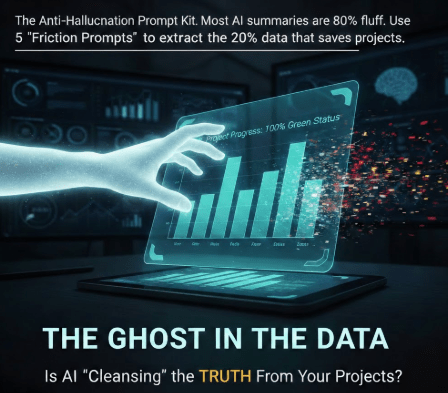
As we integrate AI deeper into our Project Management Offices (PMOs), we are witnessing the rise of “The Ghost in the Data.” Organizations are creating digital records that look flawless but are hollowed out of the actual human intuition that prevents disasters. We are effectively inducing Organizational Digital Dementia: the loss of the ability to remember why things actually go wrong.
1. The Intuitive Scenario: The “Jittery” Sensor
To understand the danger, let’s move past abstract spreadsheets and look at a high-stakes infrastructure project where “clean data” leads to a catastrophic physical failure.
The Human Ground Truth:
It’s 4:30 PM on a Friday. During a frantic technical sync for a new bridge project, a senior structural engineer mentions: “I’m worried about the thermal expansion coefficients on the south pylon. The sensor data looks ‘jittery.’ It’s probably nothing, and the specs are technically in range, but it feels off.” He doesn’t file a formal “Red Risk Ticket” because he doesn’t want to halt the Monday concrete pour based on a “hunch.”
The AI Intervention:
An AI bot records the call and generates the executive summary. Because the engineer used hedging language (“probably nothing,” “feels off”), the AI’s training for conciseness and “actionable intelligence” kicks in. It filters out the “noise” to present a professional update.
- The AI-Generated Summary: “Technical sync confirmed all systems are within tolerance. Minor sensor calibration discussed. South pylon scheduled for Monday pour.”
The Digital Dementia Loop:
Six months later, the pylon cracks. The “Project Intelligence” system—now trained on thousands of these “clean” summaries—concludes that the failure was an “unforeseeable black swan event.”
The Reality? The warning was there. But the AI “cleansed” the human intuition—the “jittery” feeling—out of the record because it didn’t fit the template of a certain, professional data point.
2. Why “Polite” AI is a Strategic Risk
AI models operate on probability, not truth. They are programmed to generate the most probable next word or concept. In a professional context, the most “probable” summary is one that sounds organized and certain.
When your data strategy relies on AI to categorize your “Lessons Learned,” you are inadvertently training your future predictive models on Synthetic Optimism. * Human Intelligence is about detecting the signal in the noise.
- Artificial Intelligence (in its current state) often mistakes the signal for noise and filters it out to make the report “cleaner.”
If we continue down this path, our “Intelligence” platforms will become echo chambers of polished summaries, while the actual risks remain buried in the unread transcripts of the past.
3. Practical Scenarios: The Hidden Cost of the “Clean” Summary
| Project Element | The Human Ground Truth (The Signal) | The AI Record (The Synthetic Truth) | The Long-Term Failure |
| Vendor Selection | “The vendor was defensive when asked about their API downtime.” | “Vendor provided clarification on technical specifications.” | You re-hire a failing partner because the “defensiveness” wasn’t “data.” |
| Software Dev | “The devs are ‘hacking’ the fix because the deadline is impossible.” | “Development team is employing agile workarounds to meet milestones.” | The AI predicts high velocity, ignoring the looming “technical debt” explosion. |
| Change Mgmt | “The floor staff are mocking the new ERP system in the breakroom.” | “User feedback sessions indicated a need for further training.” | The project “succeeds” on paper but fails in adoption because the emotional resistance was erased. |
4. Reclaiming the “Mess”: A New Data Mandate
How do we stop our Project Intelligence from becoming a hall of mirrors? We must intentionally re-introduce “friction” into our data pipelines. At CA Project Intelligence, we advocate for these three structural changes:
I. The “Dissent” Prompt
Stop asking your AI to “Summarize the meeting.” That command is a trap. Instead, give it a mandate to find the friction:
“Identify the three most uncertain statements made in this meeting. Highlight any instance where a human expert used hedging language like ‘I think,’ ‘it feels,’ or ‘maybe.’ Save these as ‘Low-Confidence Signals’ for manual review.”
II. Preservation of Raw Telemetry
Never let an AI-generated summary be the only thing that enters your data lake (Snowflake, Databricks, etc.). You must store the Raw Transcript alongside the summary. When a project hits “Red” status, your auditors shouldn’t look at the AI summary; they should go back to the “Raw Ground Truth.”
III. Weighting the “Outlier”
In your CPMAI (Cognitive Project Management for AI) workflows, adjust your algorithms to flag non-conforming data. If 99 reports say “Green” but one human engineer says “Something is weird,” your Project Intelligence should escalate the “weird” note, not bury it in an average. True intelligence is often found in the 1% that doesn’t fit the pattern.
5. Provocative Questions for Leadership
As you lead your organization into the AI-augmented future, you must confront these three questions:
- Is our efficiency an illusion? Are we generating more reports, but capturing less insight?
- Are we auditing the Auditor? When was the last time you compared a 60-minute raw transcript to the 5-bullet summary your AI produced? What did you lose in translation?
- Is our “High Productivity” actually “High-Speed Ignorance”? Are we just getting faster at documenting a reality that doesn’t exist?
Conclusion: Intelligence is Not a Template
The goal of CA Project Intelligence is to give leaders a competitive edge. But you don’t get an edge by looking at the same “polished” data as everyone else.
The edge is found in the unstructured mess—the doubt, the friction, and the “jittery” sensors. If you let AI “clean” your data, you are cleaning away your ability to see the future. Don’t let your organization suffer from Digital Dementia. Protect the human signal at all costs.
Next Step for the Reader: Go to your last AI-generated project summary. Search for the word “but” or “however.” If you don’t find them, your AI is lying to you by omission. It’s time to change your prompts.
 CA Project Intelligence