In the first two installments of this series—The CEO’s AI Blueprint and Beyond the Blueprint—we focused on the strategic “Why” and the initial audit of data assets. We established that AI is a leadership discipline. But as we move into Phase III of the CPMAI methodology: Data Preparation, the conversation shifts from vision to Operational Integrity.
For a President or CEO, Phase III is often the most misunderstood part of the journey. It is where the “80/20 Rule” of AI hits the balance sheet: 80% of your project’s effort and budget will be spent on the preparation of data, while only 20% goes toward the “intelligent” model.
If you view this 80% as a technical delay, you are misreading the market. In reality, Phase III is where you build the Supply Chain of Truth for your organization. It is the process of turning raw, liability-prone data into a high-octane corporate asset.
The Executive “Why”: Preparation as Insurance
To understand the “Why” of Phase III, look past the code and focus on Risk. In Phase 1, we defined the business goal. In Phase 2, we looked at what data we had. In Phase 3, we ensure that data is actually fit for purpose.
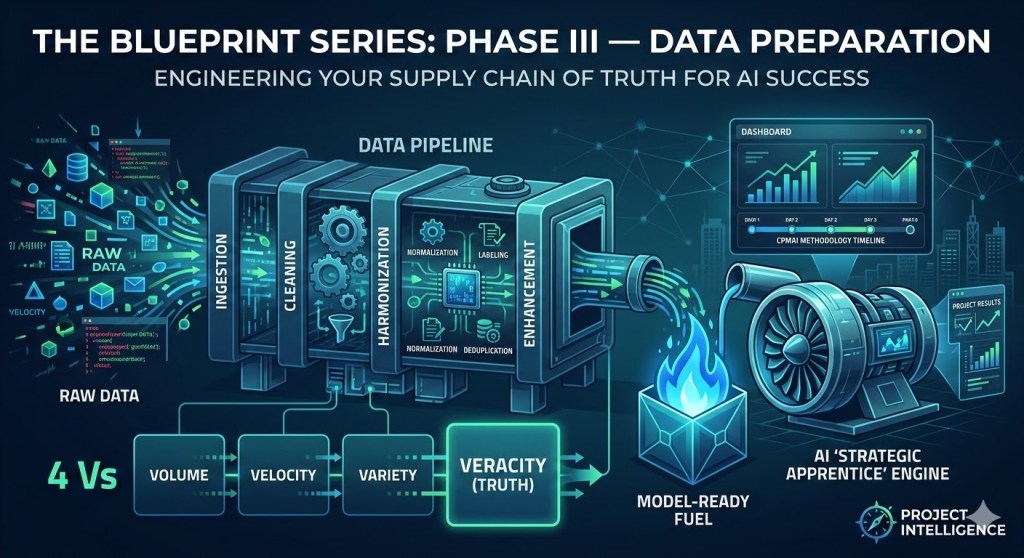
Think of this phase as the Refinery. You can own the largest oil field in the world (Phase 2: Data Understanding), but you cannot put crude oil into a jet engine. If you do, the engine seizes. In AI, “seizing” looks like biased results, hallucinating models, and catastrophic strategic errors. Phase 3 is the mandatory engineering required to ensure your “engine” (the AI) doesn’t just run, but dominates.
The 4 Vs: Your Strategic Guardrails
An executive should not manage the pipeline, but you must hold your team accountable to the 4 Vs of CPMAI. These are your high-level metrics for project health and investment readiness:
- Volume: Do we have the depth of data required to make a statistically significant decision?
- Velocity: Is our preparation process fast enough to keep pace with the market?
- Variety: Are we preparing a diverse enough dataset to avoid the “echo chamber” effect in our AI?
- Veracity (The CEO’s Priority): This is the “Truth” metric. Phase 3 is entirely dedicated to ensuring Veracity. Without it, the other three Vs only help your organization make the wrong decisions at a massive scale.
Precision Stewardship: Moving Beyond “Cleaning”
We must stop using the term “data cleaning” as if it were a menial chore. In a high-stakes Project Intelligence environment, we perform Precision Stewardship. This is a high-value governance role.
- The Data Engineer builds the automated, scalable pipelines—the “conveyor belts” of your intelligence.
- The Data Steward acts as the Quality Controller. They ensure your data is normalized, ethical, and representative.
The Executive Reality: If you task your expensive Data Scientists with the manual labor of data preparation, you are misallocating capital. Phase 3 requires a dedicated engineering mindset to build a repeatable, automated system.
The Decision Gate: The “Go/No-Go” Milestone
The most important “Why” for a CEO regarding Phase 3 is that it serves as the ultimate Decision Gate.
According to the CPMAI framework, Phase 3 is the moment of truth. If the data preparation reveals that the data is too “noisy,” too biased, or too sparse, the project must stop or iterate. A leader’s greatest strength in this phase is the willingness to say: “The fuel isn’t ready. We will not risk the engine.” Rushing through Phase 3 to get to the “cool” AI results is how companies end up as cautionary tales in the Wall Street Journal.
The Executive’s Phase III Checklist
As you review your AI roadmap, use these three “Litmus Test” questions to ensure your team is adhering to the CPMAI Phase III standard:
- The Scalability Test: “Is our preparation a one-time manual ‘hack,’ or have we built an automated pipeline that we can use for our next ten projects?”
- The Veracity Audit: “What is our confidence score in this data? Have we identified the ‘ghost records’ that could skew our ROI?”
- The Strategic Gate: “If the data preparation shows we are missing key context, are we prepared to pause and fix the source before we train the model?”
Conclusion: Preparation is the Competitive Advantage
Phase 3: Data Preparation is not a technical hurdle; it is a Strategic Foundation. Organizations that master the engineering of their data pipelines pivot faster, scale easier, and avoid the catastrophic reputational risks of flawed AI.
As a leader, your job is to ensure the “fuel” is as sophisticated as the “engine.” When the infrastructure is prepared, the Intelligence is inevitable.

