
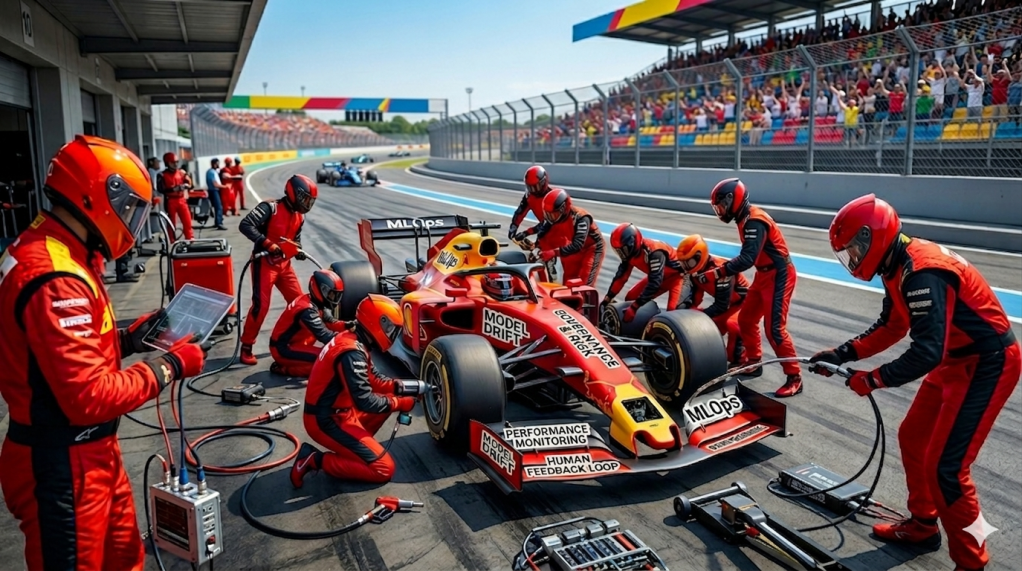
You’ve done the hard part. You’ve survived the discovery sessions of Phase I, the data audits of Phase II and III, and the “Algorithm Auditions” of Phase IV. You even held the line during Phase V’s evaluation, ensuring the model didn’t just work, but worked safely. Now comes the moment most leaders mistake for the finish line: Phase VI, Model Operationalization.
To understand Phase VI, stop thinking about software and start thinking about a Formula 1 race car. You don’t just buy a Ferrari and expect it to win the Monaco Grand Prix on its own. You need a pit crew, a driver who understands the car’s limits, and a constant stream of telemetry data to adjust the engine mid-race. In the world of the CPMAI (Cognitive Project Management for AI) methodology, this is where the “science project” ends and the “business asset” begins.
The “Day 2” Reality: The Pit Crew Mentality
Deployment isn’t a “handover”; it’s a launch. Imagine yourself as a CEO investing heavily in a predictive sales AI. It was a masterpiece in the lab. But once “on the track,” the sales team realized the model didn’t understand a new competitor’s aggressive pricing strategy. Because there was no “pit crew” (Operationalization plan) to retune the model, the sales team stopped trusting the car and went back to walking.
Phase VI is about integration. It’s making sure the AI isn’t a shiny hood ornament, but the engine driving the car. As a CEO, your focus here isn’t on the API calls or the containerization; it’s on Workflow Integration. If the AI’s insights aren’t delivered to your employees in the tools they already use, at the exact moment they need to make a decision, you haven’t deployed AI—you’ve just built an expensive calculator that no one uses.
Guarding Against the Silent Killer: Model Drift
If you drive a high-performance car at 200 mph, the alignment will eventually shift. In AI, this is Model Drift. The world changes—consumer habits shift, competitors launch new pricing, or a global pandemic flips the script—and suddenly, the data your model was trained on is a “track” that no longer exists.
The danger for a CEO is that drift doesn’t usually cause a system crash. The lights stay green. The reports still run. But the accuracy of the decisions degrades. You might find your marketing AI spending millions targeting a demographic that no longer exists, or your fraud detection system flagging your best customers.
The CEO’s Action Item: Ask your team for a “Drift Dashboard.” You don’t need to see the math, but you do need to see a “Business Health” metric that triggers an alert when the model’s real-world performance deviates from the Phase V benchmarks. If the car starts pulling to the left, you need to know before it hits the wall.
The “Kill Switch” Strategy: Governance as a Business Asset
In 2026, AI governance is no longer just a legal checkbox; it is a brand-protection strategy. Part of CPMAI Phase VI is establishing clear Incident Playbooks. Think of it like a nuclear power plant or a high-end racing vehicle. You don’t build the reactor without a containment structure and a shutdown procedure.
As a leader, you need to know:
- Who owns the model? (Hint: It should be a business lead, not just the CTO).
- What is the “Kill Switch” protocol? If the model starts hallucinating or exhibiting bias during a live customer interaction, who has the authority to take it offline, and what is the manual fallback process?
Governance ensures that when—not if—the model encounters an edge case it wasn’t trained for, your company’s reputation remains intact. It is the braking system that allows you to go fast in the first place.
The Hidden Cost: Managing Inference and Scalability
A Ferrari uses more fuel than a Honda. Similarly, a successful AI uses more “compute” as it scales. Many CEOs are blindsided by the “Success Tax.” A model that costs $500 a month to run for a small pilot group might cost $50,000 a month when rolled out to your entire global sales force. This is the cost of Inference—the computational power required every time the AI “thinks.”
Phase VI requires you to look at the Unit Economics of AI. If the cost to serve an AI-generated recommendation is higher than the margin that recommendation generates, your “successful” deployment is actually a financial leak. CPMAI teaches us to monitor these MLOps (Machine Learning Operations) costs as strictly as we monitor any other utility. You must manage the fuel consumption of your AI to ensure it remains a profitable asset, not a vanity project.
Cultural Operationalization: Closing the Trust Gap
The final piece of the CPMAI puzzle is the one most CEOs ignore: The People. When you move a model into production, you are effectively introducing a new “digital employee” into the mix. If your staff feels threatened by it, or if they don’t understand why the AI is making certain recommendations, they will find ways to bypass it.
“Shadow AI” or “Manual Workarounds” can cripple multimillion-dollar investments. Employees will keep their own Excel sheets on the side because “the machine doesn’t understand our customers like I do.” To truly operationalize AI, you must lead a cultural shift. This means transparency regarding the “Why” behind the AI’s role and aligning KPIs so managers are rewarded for successful AI adoption, not just traditional metrics.
The Iterative Loop: Back to the Starting Line
The CPMAI methodology is a circle, not a line. Phase VI—Operationalization—is actually the gateway back to Phase I. The data you gather while “living with the machine” becomes the “Business Understanding” for your next big move. In racing, the data from today’s race informs the design of next year’s car.
As we conclude this CEO Blueprint Series, remember this: AI is not a trophy to be won. It is a capability to be mastered. The CEOs who win in this era won’t be the ones who launched the most “pilots.” They will be the ones who built a disciplined, repeatable process for ensuring their AI investments remain accurate, ethical, and profitable long after the launch party is over.
The CEO’s Phase VI Completion Checklist (The Pit Manual)
- Twin Dashboards: Is it making money and staying accurate? (CPMAI: Model Monitoring)
- The Kill Switch: Who stops the car if it veers off track? (CPMAI: Governance & Risk)
- Model Provenance: Can we audit why a decision was made? (CPMAI: Model Versioning)
- Inference Budget: Will scaling this break our margins? (CPMAI: MLOps & Scalability)
- The Feedback Loop: Are the “drivers” (staff) telling us what’s wrong? (CPMAI: Human-in-the-Loop)
 CA Project Intelligence