Let’s be blunt: the novelty of “prompting” a chatbot is wearing thin. For the past two years, the C-suite has been mesmerized by the ability of Large Language Models to draft emails and summarize meetings. But if you are still viewing AI through the lens of a smarter search bar or a faster intern, you are treating a jet engine like a ceiling fan.
The “glittering promise” of AI isn’t found in its ability to say things; it’s found in its ability to do things. We are entering the era of Agentic AI—a shift from reactive tools to an autonomous digital workforce. For the modern CEO, this isn’t just a technical upgrade; it is a fundamental shift in how you orchestrate your organization’s productivity.
Defining the Shift: Chat vs. Agent
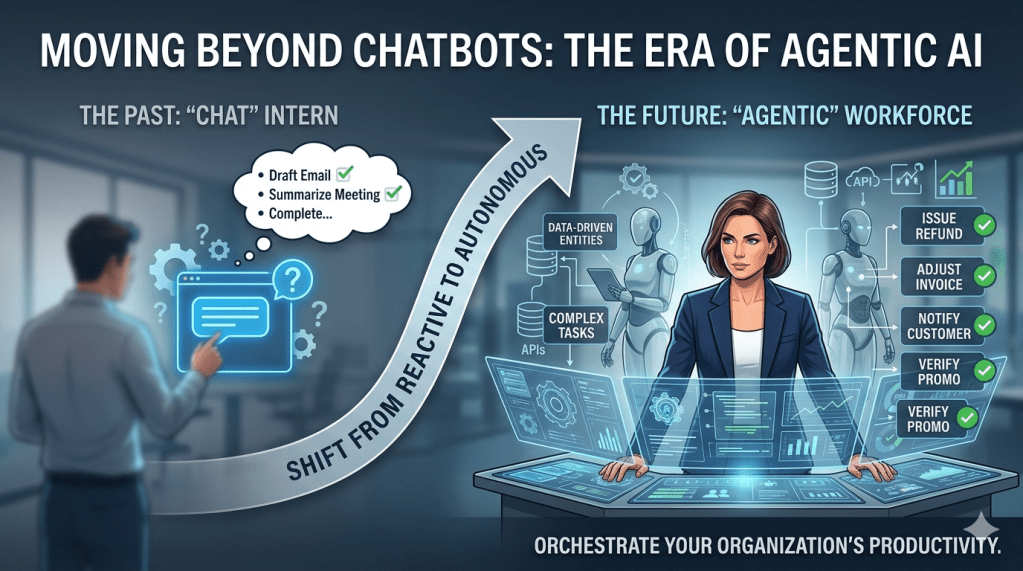
In the traditional AI paradigm, the human is the engine. You provide the prompt, and the AI provides the response. This is a linear, high-touch interaction. Agentic AI flips this script. Drawing from the CPMAI methodology, an agent is a system designed to perceive its environment, plan a course of action, and execute that plan across multiple systems with minimal human intervention.
Think of it this way: Chat AI is a highly skilled intern waiting at their desk for your next instruction. Agentic AI is a seasoned Project Manager who identifies the objective, gathers the necessary resources, and comes back to you only when the job is done or a critical decision is required.
The Anatomy of Agency: A 60-Second Case Study
To understand the ROI gap between “Chat” and “Agency,” look at a common business friction point: the complex billing dispute.
The “Chat” Reality: A high-value customer sends a message: “Why was I overcharged on my last invoice?” A standard AI chatbot parses the text and responds: “I see you have a billing question. Here is a link to our refund policy and the phone number for our support team.”
- The Result: The customer is still frustrated, and a human support agent still has to do 100% of the manual labor to investigate and resolve the issue. ROI: Negligible.
The “Agent” Reality: The same customer asks the same question. The Agentic Ecosystem takes over:
- Perceives: It identifies the specific transaction, cross-references it with the customer’s loyalty tier, and notes a mismatched promotional code.
- Plans: It determines it needs to query the billing database, verify the promotional terms from the marketing repository, and check the refund limit for its current permission level.
- Acts: It calls the billing API to calculate the exact credit, drafts an adjustment, and notifies the customer: “I’ve identified an applied discount error on your March invoice. I have initiated a $45 credit to your account. Would you like me to apply this to your next balance or refund it to your card?”
- The Result: The ticket is closed autonomously. The customer is delighted by the speed. The human agent only intervenes if the anomaly exceeds a specific dollar threshold. ROI: Transformational.
The CEO’s Orchestration Challenge: Managing the Ecosystem
As a leader, your role is shifting from “Prompter” to “Orchestrator.” To reach the level of agency described above, you must move past the “plug-and-play” mindset. Agentic systems are biological assets; they require Model Scaffolding—the specialized infrastructure of APIs, interfaces, and security layers that allow an agent to actually interact with your company’s “real world.”
This requires a strategic shift in resource allocation. You must understand that the infrastructure needed for the Inference Phase (the moment the agent is actually performing work) is vastly different from the infrastructure used to train the model. Leading an agentic workforce means investing in the Orchestration platforms that prevent these autonomous systems from becoming digital runaways.
Managing “Emergent Behaviors”: Risk and Accountability
Autonomy brings a new category of risk: emergent behaviors. When an agent has the power to act across systems, it can make decisions that were not explicitly programmed. This is why the CPMAI framework demands a “Human-in-the-loop” for any high-stakes outcome.
You cannot have agency without transparency. As a CEO, you must demand comprehensive audit trails. If an agent denies a loan or issues a credit, your systems must be able to reconstruct the “thought process” of that agent for regulatory compliance. Accountability cannot be outsourced to an algorithm. You are responsible for the “intelligence” your company creates.
Beyond “One-and-Done”: The Continuous Life Cycle
Perhaps the most dangerous trap for an executive is the “capital expense” mindset—the idea that you buy the AI and then you’re done. AI models are probabilistic, and agents, because they interact with “messy” real-world data, are subject to drift.
The world changes. Your competitors change. Your customers change. Without ongoing MLOps (Machine Learning Operations) and performance dashboards, your agentic workforce will experience performance decay. An agent that was 95% effective in January might be a liability by July if its data foundations haven’t been refreshed.
Conclusion: From Prompter to Orchestrator
The competitive advantage of the next five years will not belong to the company with the “best prompts.” It will belong to the organization with the best-governed agents.
Stop asking what your AI can say. Start asking what your AI can do. When you stop treating AI as a chatbot and start treating it as a workforce, you stop chasing the hype and start building a foundation for scalable, autonomous ROI.
Don’t just deploy. Orchestrate.

