
By Robert Calla, CA Project Intelligence
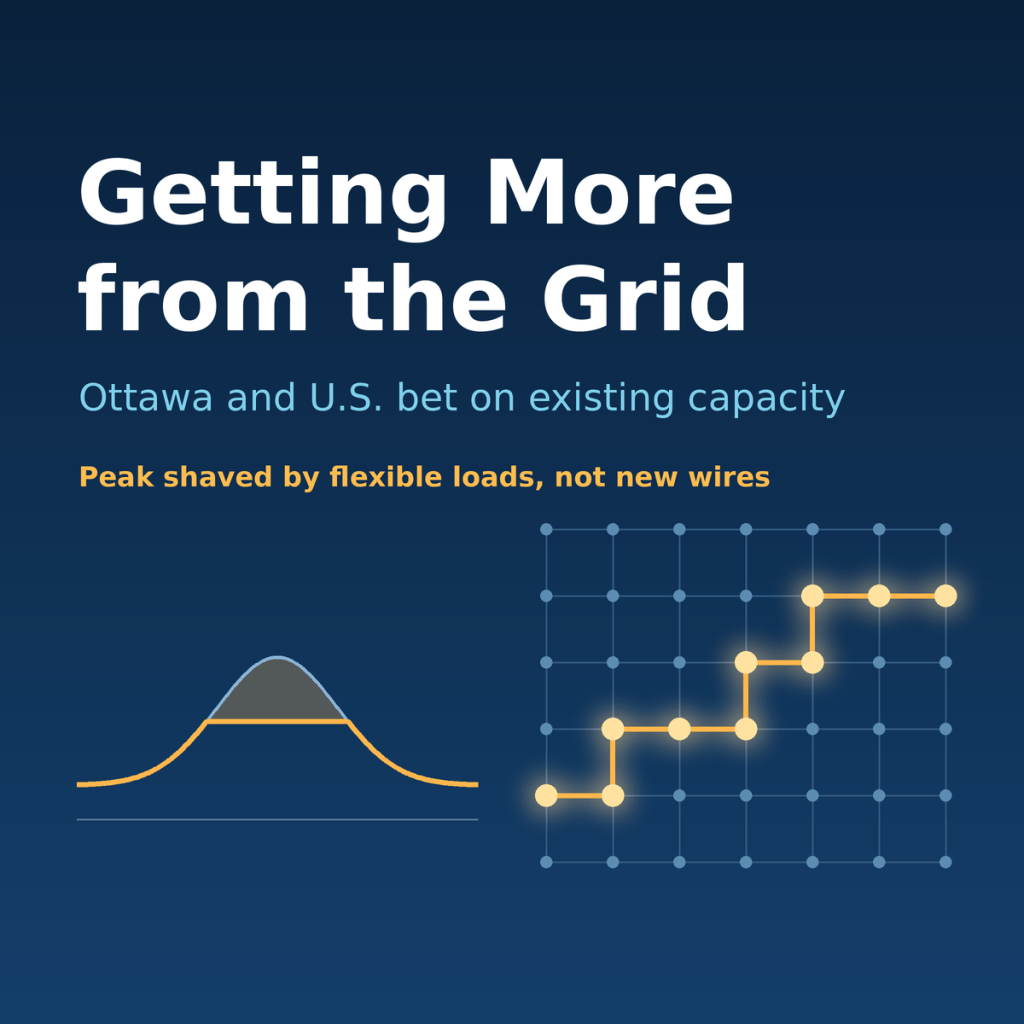
On December 11, 2025, the Canadian federal government announced $6 million for Hydro Ottawa to test something that sounds technical but matters to every household in a growing city: can artificial intelligence help the utility meet new demand by managing existing grid capacity, instead of building more wires first?
Just over nine months later, on September 24, 2026, the U.S. Department of Energy announced nearly $2 billion for a similar bet on a national scale. The two stories come from different countries and different budgets. They share one idea that is worth understanding.
What Ottawa is testing
The project is called ODERA, short for the Ottawa Distributed Energy Resource Accelerator. According to Natural Resources Canada, here is what it does:
- Forecasting: Hydro Ottawa uses AI-enhanced load forecasting for individual distribution transformers and feeders. In plain language, it predicts where and when demand will peak on small sections of the neighbourhood grid, rather than only across the city as a whole.
- Response: Those forecasts guide demand-response signals to customer-owned devices such as smart thermostats, electric vehicle (EV) chargers and home batteries, turning them into what the federal release calls “valuable, responsive grid resources.”
- Where: ODERA is a pilot for high-growth neighbourhoods like Kanata North. Hydro Ottawa CEO Bryce Conrad called it “more than just a solution for the capacity constraints we face in high-growth areas of our city, like Kanata North,” and “a scalable blueprint” for the rest of the service territory.
- Cost: Natural Resources Canada’s (NRCan) project page lists the total project cost at $14,638,124 and the agreement value at $6 million, under the federal Energy Innovation Program.
NRCan’s project page describes the approach as a non-wires alternative. That term means a way to meet growing electricity needs without building new poles, wires and substations. Energy Minister Tim Hodgson said ODERA “will support making Ottawa’s grid more efficient and reduce the need for costly infrastructure upgrades.”
The U.S. parallel
The Associated Press, in a report published by PBS NewsHour, described the U.S. Department of Energy (DOE) program this way:
- Funding: $1.9 billion in federal funding across 31 projects in 26 states, matched by $3.35 billion in cost-sharing contributions from recipients.
- Target: More than 23 gigawatts of added capacity, which the department says is enough for about 16 million homes.
- Scope: Component upgrades on more than 1,500 miles of transmission lines and technology upgrades across nearly 21,000 miles.
- Selection: Projects were prioritized partly on how quickly they could begin operating.
The common theme: decisions, not just steel
Ottawa’s pilot works at the neighbourhood level; the DOE program operates on a national scale. Both aim to increase capacity by making better use of existing infrastructure.
Hardware matters. But the capacity a system delivers on a given day also depends on operating decisions: how equipment is rated, how load is forecast, how supply is dispatched and when maintenance happens. Those decisions are often made by separate teams using separate data, with assumptions that change slowly. That can be a sensible way to manage risk. It can also leave capacity underused.
AI has a practical role here. It does not replace engineering judgement. It can bring scattered data into one view and help teams test decisions before they are made.
What the early evidence shows
Two U.S. utilities illustrate both reported benefits and projected gains. The details come from POWER Magazine.
NextEra Energy built a platform called Grid Composer that combines real-time telemetry, load data and generation profiles into one model. NextEra’s Rich Argentieri told POWER the first version was built in “less than 12 weeks,” and that optimized dispatch and outage scheduling produced “over $20 million of savings to our customers” at the time of the report. He put the data volume at “roughly half a trillion data points a day.” He credited much of the value to breaking down silos between teams that used to work from separate data.
Santee Cooper, South Carolina’s state-owned utility, shows why forecasting matters. Its CFO, Tami Wilson, told the roundtable that “on the coldest winter day, one degree of temperature variance can cost up to $100,000 per hour on the spot market,” and can shift needs by “roughly 100 megawatts an hour.” The utility expects an AI tool to cut the time it takes to run financial scenarios by about 75%, but POWER notes the utility “hasn’t yet tested” the tool in production.
What none of this proves yet
The evidence comes with important limits:
- ODERA is a funded pilot announced in December 2025. I have not found published results yet. NRCan’s project page also does not specify how many customers or devices are involved, the targeted capacity in megawatts or the project timeline.
- NextEra’s $20 million is a company-reported figure, not an independently audited one.
- Santee Cooper’s anticipated gains remain largely projected.
- The utility examples are separate from the DOE announcement, and the Associated Press coverage does not describe the DOE projects as AI-driven.
What the examples illustrate is the shape of the opportunity: gains from better decisions about assets that already exist. Ottawa’s pilot will test whether that approach can deliver benefits at the neighbourhood level.
Why this matters on the building side
ODERA, as announced, includes thermostats, EV chargers and home batteries. I have not seen details on whether commercial buildings are part of the pilot. But I have worked in building energy modelling and mechanical systems for more than 30 years, and the pattern is familiar on the customer side of the meter.
Large buildings often run on control sequences and setpoints established at commissioning and rarely revisited. Equipment is sized for design conditions that may occur only a few days a year. Energy, maintenance and capital planning sit with different groups. A building that can shift load for a short period on request can become a grid resource. Whether it does depends on controls, data and decisions made well before any utility signal arrives.
Questions to ask before your next capital project
- Where are our limits set by fixed assumptions rather than measured conditions? These are the likeliest places to find unused capacity.
- Which decisions affect each other but are made by separate teams? Energy and capital planning, or operations and maintenance, are common examples.
- What does a forecast error cost us? Santee Cooper can put a number on it. Most organizations cannot, and that is a finding in itself.
- Is our data good enough? AI depends on data that is accessible, consistent and trusted. In my experience, this is usually the real constraint.
- What governance will surround AI-assisted decisions? Santee Cooper is establishing a cross-functional Innovation Council and using a “human in the loop” approach. Define approval processes, accountability and training requirements before deployment, not after.
Conclusion
Ottawa and Washington are making a similar bet at different scales: that a meaningful share of new capacity can come from better use of infrastructure already in service. The U.S. utility examples suggest that value depends on the quality of operating decisions and that AI can help improve those decisions when supported by good data and sound governance. Hydro Ottawa’s pilot is a chance to test that approach close to home.
Some of the most affordable capacity may be the capacity you already own. The work is learning to use it.
Join the conversation
Which of the five questions above would be hardest for your organization to answer today? Share your experience in the comments. I read every one, and practical examples from the field are what make these discussions useful. If you found this article valuable, please subscribe and pass it along to a colleague working on grid or building performance.
Why I write these articles
I write this series to raise awareness of how AI can help accelerate cleantech and energy sustainability goals when it is thoughtfully integrated into a business strategy rather than adopted as a stand-alone tool. The technology is moving quickly. The organizations that benefit most will be those that connect it to clear business outcomes, sound data and good governance.
To learn more about my work, visit caprojectintelligence.com.
Robert Calla is the founder and principal consultant of CA Project Intelligence, an Ottawa-based advisory practice focused on AI strategy for clean energy, buildings and mechanical systems. He holds PMP and PMI-CPMAI certifications.
CA Project Intelligence – intelligent solutions for ambitious energy and sustainability projects.

