
Prepared for building managers and facility operators.
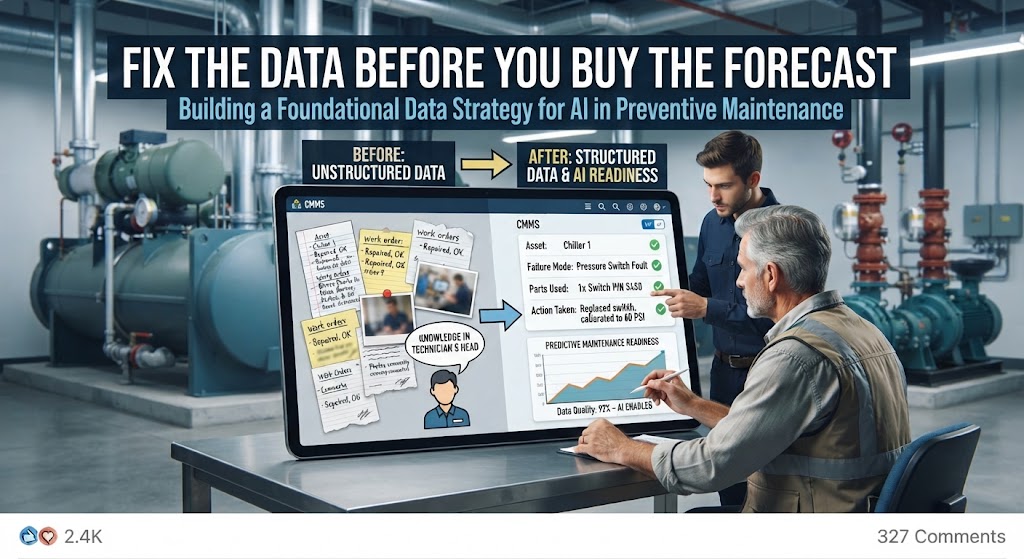
The 50% problem
Leaders estimate their maintenance teams complete about 54% of scheduled preventive maintenance. That number comes from Limble’s State of Maintenance survey, which drew 686 full-time U.S. maintenance and operations employees between July 29 and August 6, 2026. The margin of error is ±3.7 points at 95% confidence. Facilities Dive covered the findings in October.
Limble sells a CMMS (computerized maintenance management system), so treat the findings as directional. The survey is still useful because it shows where the gap sits.
What the numbers say
According to the press release, 82% of organizations own and operate a CMMS, but only 39% report consistent use across the whole team. 71% have asked a colleague for information the system already holds. Limble separately reports that 74% of maintenance organizations have at least one critical asset that exactly one staff member knows how to fix. That figure comes from separate findings, not the survey itself.
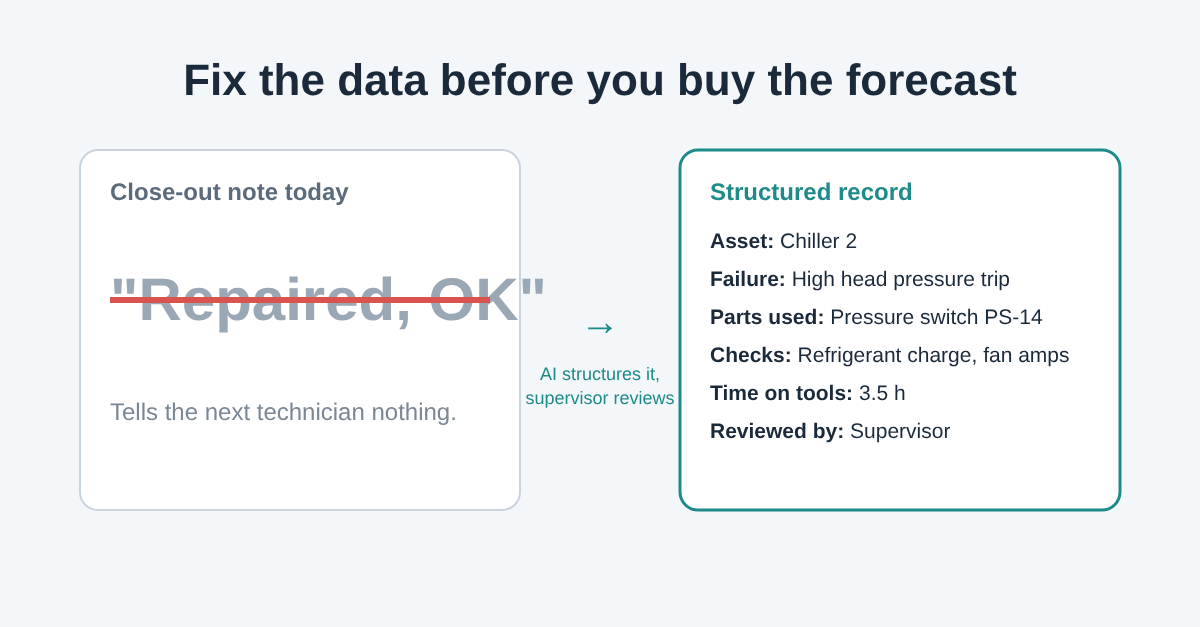
Put together, the picture is not a shortage of software. It is a shortage of complete, consistent records. Maintenance history lives in people’s heads and in close-out notes like “repaired, OK,” which tell the next technician nothing.
The survey also reports that 55% of teams are using or piloting AI, and that 92% agree AI needs good, complete maintenance data. I put more trust in the second number. The first depends on how “piloting” was defined, and the coverage doesn’t say.
Why predictive AI stalls
Predictive maintenance models learn from failure history, run times, and work orders. If those records are incomplete or inconsistent, the model learns the wrong things. It can flag an asset that is fine and miss one that is failing, and the people who know better will stop trusting it.
Limble’s CEO, Gary Specter, put it this way in the press release: “Adding AI won’t automatically solve the problems they face every day.” In the Facilities Dive coverage he also says that most maintenance teams “aren’t short on technology,” but are short on time and information they can trust.
Start with capture
The most useful AI I see in building operations today is at the input end. Anyone who has taken over a central plant knows the real O&M manual is the senior operator, and that knowledge rarely makes it into the system. A workable approach:
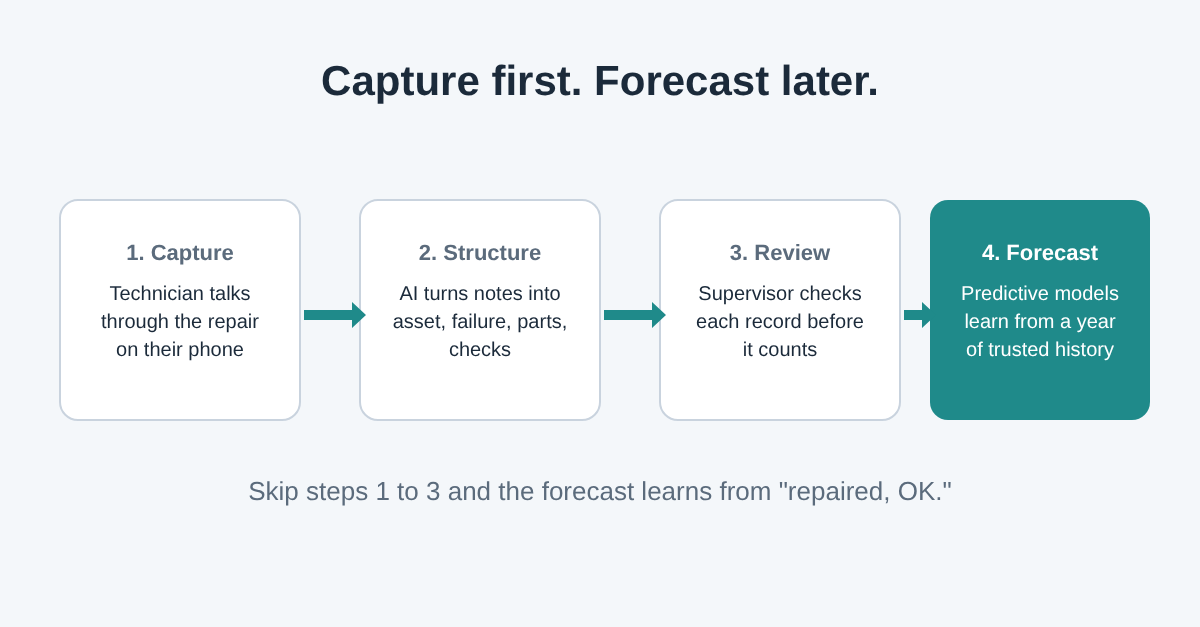
- Capture at the job. The technician talks through the repair on their phone as they do it and adds a few photos.
- Structure it automatically. The tool turns the notes into a record: asset, failure mode, parts used, time on tools, and what was checked first. Language models handle this kind of structuring well today.
- Capture the experts before they retire. Sit the person who knows the chiller down with the same tool. Their knowledge becomes part of the record.
- Review before it counts. A supervisor approves the record. Human review keeps the data trustworthy.
- Build the history. After a year, you have the failure data that predictive models need.
Most of this is a process change first and a technology change second. The tool matters less than the habit of recording what was actually done.
What building managers and operators can do now
If you run a portfolio, or a facility, these steps help whatever software you use:
- Find the single-person assets. List every critical system that only one person can fix. Name a backup or document the procedure this month.
- Set a close-out standard. Define what a complete work order looks like: cause, action, parts, and what to check next time. “Repaired, OK” is not a record.
- Check CMMS adoption. If only some of the team uses the system, find out why before buying anything new.
- Pilot capture on one plant or one building. Test the process on a single site before rolling it out.
- Define good data before buying a forecast. Decide what “complete” means for your assets, and measure it.
These are not glamorous, but they determine whether any later AI investment pays off. A peer group, a working session, or your own operations meeting is a good place to start.
Why I developed MAPS
I know this gap from the inside. Years ago I developed MAPS (Maintenance Analysis and Planning Software), built on an extensive maintenance database from the US Army Corps of Engineers. Building it proved how much a maintenance program’s value depends on records that are complete and consistent.
Why I write about this
I have spent more than 30 years in buildings energy, mechanical systems, and building automation. I write to raise awareness of how AI, treated as a carefully planned business strategy, can help accelerate clean energy and sustainability goals in buildings and on the grid. I’d rather see operators get the basics right than buy a forecast they can’t trust.
How CA Project Intelligence can help
Many organizations hold their most valuable maintenance knowledge in unstructured form: technician notes, emails, photos, old manuals, and the memories of senior staff. I use AI techniques to capture that knowledge, organize it into usable records, and identify where your business processes are losing time and information. The result is a stronger base for both daily operations and any future predictive work.
If your organization is facing this, I’d like to hear about it. You can reach me through caprojectintelligence.com.
CA Project Intelligence – intelligent solutions for ambitious energy and sustainability projects.

